
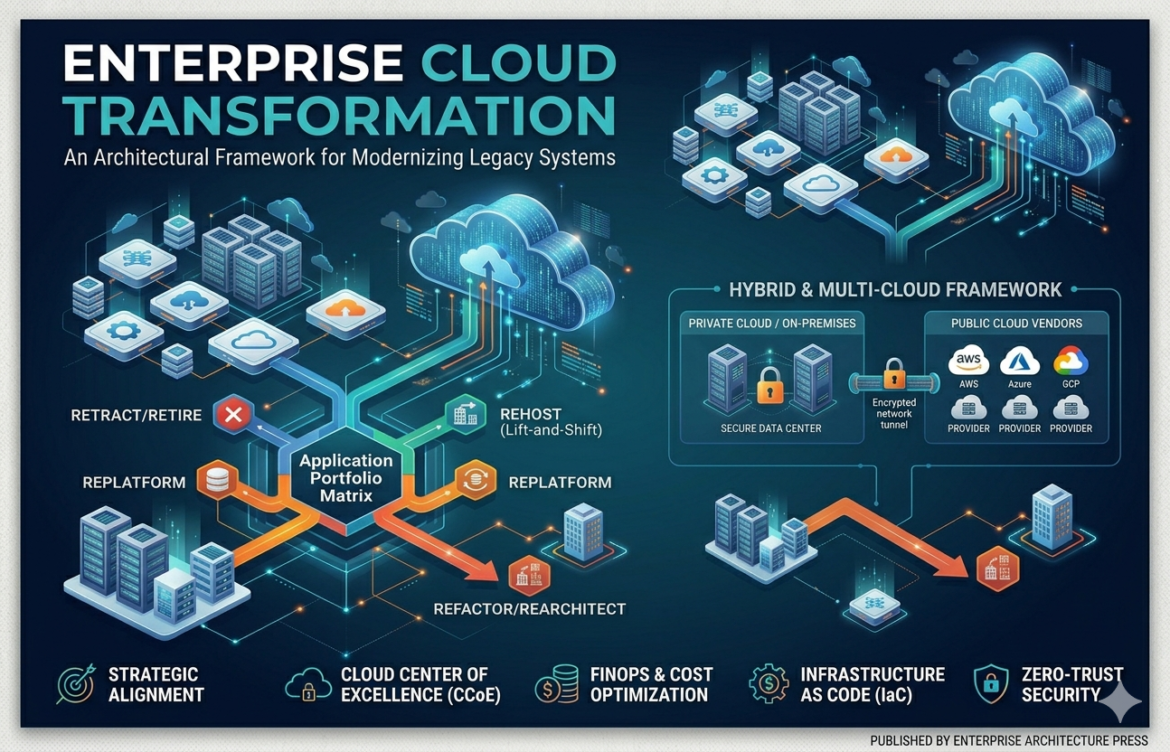
Enterprise Cloud Transformation: The Architectural Framework
The modern enterprise marketplace demands unprecedented operational agility, systemic resilience, and continuous technological innovation. To achieve these benchmarks, organizations must look past standard hosting strategies and commit to a comprehensive digital restructuring. Executing an enterprise cloud transformation is no longer a simple infrastructure choice; it is a critical business imperative that redefines how an organization delivers long-term value.
However, many executive teams approach this migration with an outdated mindset. Treating the shift to cloud infrastructure as a basic data center relocation often results in runaway operating expenses, fragmented governance, and persistent technical debt. True modernization requires a deep, systematic overhaul of your application architecture, operational culture, team alignment, and financial oversight strategies.
This comprehensive guide delivers an enterprise-grade architectural blueprint designed to de-risk your cloud journey. By unpacking structured migration frameworks, advanced FinOps workflows, and modern cloud-native design principles, this article provides the strategic clarity required to transform your legacy IT footprint into a highly competitive, scalable innovation engine.
Quick Answer
An enterprise cloud transformation is the systematic modernization of an organization’s entire digital ecosystem. This involves moving legacy infrastructure, applications, data workflows, and organizational cultures into an optimized hybrid or multi-cloud environment. Successful transformation relies on deep application portfolio assessments, cloud-native refactoring, robust automated governance, and strategic business alignment to drive scalable growth and optimize long-term operational costs.
What You’ll Learn
- How to build an adaptable enterprise architecture strategy tailored to complex legacy application portfolios.
- The mechanical differences between application refactoring, replatforming, and basic lift-and-shift strategies.
- Advanced FinOps methodologies engineered to eliminate cost leaks and control operational expenditures.
- Step-by-step frameworks for establishing an autonomous Cloud Center of Excellence (CCoE).
- Mitigation strategies for complex data governance, multi-cloud compliance, and modern zero-trust security.
Why This Topic Matters
The competitive window for legacy enterprise systems is closing rapidly. Organizations running on rigid on-premises hardware face high maintenance overhead, sluggish development cycles, and significant vulnerabilities to market disruption. Modernizing your infrastructure changes the game by shifting capital expenditures into dynamic operating models, empowering teams to build and scale features at high velocity.
Furthermore, artificial intelligence, big data analytics, and real-time automation require the elastic compute capacity that only optimized cloud environments can supply. Consequently, mastering cloud-native architecture is critical to keeping your organization relevant, secure, and ready for future market shifts.
Analyzing the Enterprise Architecture Strategy
An enterprise cloud transformation cannot succeed without a clear architectural roadmap. Organizations must step away from ad-hoc deployments and move toward structured, centralized blueprints that seamlessly align technical capabilities with broader business objectives.
+-----------------------------------------------------------------+
|               Enterprise Cloud Transformation                   |
+-----------------------------------------------------------------+
                                 |
        +------------------------+------------------------+
        |                                                 |
        v                                                 v
+-------------------------------+                 +---------------+
| Application Portfolio Matrix  |                 | Hybrid/Multi  |
+-------------------------------+                 +---------------+
        |                                                 |
        +--------+--------+                               +-------+
        |        |        |                                       |
        v        v        v                                       v
     [Retain] [Rehost] [Refactor]                         [Interoperability]
Deconstructing the Application Portfolio Matrix
Before migrating a single workload, enterprise architects must execute a thorough inspection of the existing application estate. This portfolio evaluation categorizes corporate software assets based on technical health, business value, and ease of migration:
- Retain / Retire: Identify legacy applications that are nearing end-of-life or provide minimal business utility. Retain elements that cannot be moved due to rigid licensing constraints, or retire obsolete systems entirely to save budget.
- Rehost (Lift-and-Shift): Move applications directly to cloud infrastructure without modifying code. While this migration mechanism offers the fastest path out of a physical data center, it fails to capture cloud-native performance and efficiency advantages.
- Replatform: Introduce minor optimizations, such as migrating a self-hosted database to a managed cloud database service, without altering the core application code structure.
- Refactor / Rearchitect: Redesign core application codebases to adopt modern, microservices-driven architectures. This route requires the largest upfront investment but delivers maximum scalability, elasticity, and long-term cost benefits.
Navigating Hybrid and Multi-Cloud Topologies
For modern global enterprises, relying on a single cloud vendor can create unnecessary operational risks, such as regional outages or sudden pricing updates. As a result, sophisticated infrastructure strategies frequently deploy a mix of hybrid and multi-cloud models.
A hybrid cloud framework pairs secure on-premises private cloud nodes with public cloud services. This setup allows highly sensitive financial data or proprietary intellectual property to remain on-site under strict internal controls, while variable, customer-facing web traffic scales dynamically using public cloud compute capacity.
Concurrently, multi-cloud management spreads core workloads across multiple public vendors. This diversification prevents vendor lock-in, optimizes application latency across global geographies, and enables teams to leverage specialized features unique to individual cloud ecosystems.
Step-by-Step Guide to Cloud Transformation
Transforming large-scale enterprise infrastructure requires a highly ordered, multi-phased methodology. Moving systematically ensures your organization preserves operational continuity and meets strict compliance benchmarks at every stage.
Phase 1: Define Vision and Executive Alignment
Establish clear business objectives for the transformation, such as lowering total cost of ownership (TCO) or speeding up feature time-to-market. Secure binding commitments from executive leadership to sustain the program through its multi-year delivery lifecycle.
Phase 2: Establish Governance and the CCoE
Form a centralized Cloud Center of Excellence (CCoE) comprising cross-functional leaders from enterprise architecture, security operations, finance, and engineering teams. This group defines cloud design standards, security policies, and landing zone architectures across the organization.
Phase 3: Comprehensive Discovery and Mapping
Deploy automated network discovery tools to chart your entire infrastructure layout. Document all hidden application dependencies, network integrations, data storage locations, and active bandwidth utilization patterns to prevent broken connections post-migration.
Phase 4: Landing Zone Implementation
Build multi-account cloud landing zones featuring hard isolation boundaries, central single sign-on (SSO) configurations, centralized logging repositories, and pre-configured networking routes. Ensure baseline corporate security policies are enforced by default.
Phase 5: Execution of Waves and Migration
Group applications into migration waves based on dependency complexity and business criticality. Begin migration sprints with low-risk workloads to test validation routines before tackling core transactional engines and high-volume databases.
Phase 6: Continuous Optimization and Modernization
Transition applications into an active post-migration governance cycle. Use automated tooling to right-size compute resources, upgrade legacy frameworks to cloud-native variants, and tune autoscaling configurations based on real-time usage data.
Best Practices, Pro Tips, and Warnings
Best Practices
- Enforce Infrastructure as Code (IaC): Define every element of cloud infrastructure using declarative configuration languages like Terraform or OpenTofu. This practice guarantees repeatable setups, eliminates configuration drift, and simplifies tracking infrastructure updates through git repositories.
- Implement Zero-Trust Security: Treat all network locations as hostile. Implement strict identity verification, micro-segmentation, and end-to-end data encryption across all application environments.
Pro Tips
Pro Tip: Set up automated guardrails that automatically shut down or terminate unmapped non-production compute resources during non-business hours. This simple policy often cuts dev environment costs by up to 30%.
Warnings
- ⚠️ Beware of Cloud Cost Blindspots: Transitioning from predictable capital expenses to dynamic operating expenses can lead to budget overruns if engineers are allowed to spin up high-tier resources without clear budget controls.
- ⚠️ Avoid Data Egress Traps: Moving massive amounts of data out of cloud systems or between distinct cloud vendors often incurs significant data egress fees. Be sure to design data architectures to process information locally whenever possible.
Real-World Example: Financial Services Transformation
A global retail banking group faced escalating on-premises data center maintenance fees alongside slow, rigid release windows for its core digital banking app. The organization required a modern architecture capable of supporting millions of daily transactions while complying with strict regulatory data standards.
The Solution Design
The engineering team developed an advanced hybrid cloud framework:
+-----------------------------------------------------------------------+
|                       Global Retail Banking Group                     |
+-----------------------------------------------------------------------+
                                    |
            +-----------------------+-----------------------+
            |                                               |
            v                                               v
+-----------------------+                       +-----------------------+
|  Private Data Center  |                       |  Public Cloud Region  |
+-----------------------+                       +-----------------------+
| - Core Ledger DB      | <--- DirectConnect -> | - Frontend APIs       |
| - Customer PII        |      (Encrypted)      | - Notification Engine |
|                       |                       | - Stateless Services  |
+-----------------------+                       +-----------------------+
- Core Transactional Ledger: Kept inside an ultra-secure private data center on dedicated hardware to satisfy strict national regulatory mandates.
- Frontend APIs and Analytics: Migrated to an elastic public cloud region utilizing managed Kubernetes clusters for dynamic scaling.
- Secure Interconnectivity: Dedicated, hardware-encrypted cloud interconnect pipes linked the public cloud clusters to the on-premises core ledger database with sub-millisecond latency.
The Transformation Outcome
By breaking down monolithic frontend capabilities into containerized microservices, the bank reduced web application latency by 45% during peak holiday traffic. Concurrently, implementing automated Infrastructure as Code allowed deployment teams to release weekly security patches and application features without any planned service downtime, maintaining continuous application availability.
Advanced FinOps Strategies
As enterprise infrastructure scales up, standard budgeting tools often fall short. Organizations must build robust FinOps systems that bring financial accountability directly into modern DevOps engineering practices.
| Strategy Tier | Architectural Action | Primary Financial Goal | Expected Cost Reduction |
| Tier 1: Visibility | Apply automated tag validation policies across all cloud resources. | Eliminate unallocated infrastructure spend. | 10% – 15% |
| Tier 2: Efficiency | Configure automated instance right-sizing policies based on memory and CPU use. | Minimize over-provisioned infrastructure. | 20% – 25% |
| Tier 3: Commitment | Purchase rolling Multi-Year Savings Plans for predictable baseline operations. | Maximize long-term discounts on compute costs. | 30% – 40% |
Effective FinOps requires shifting accountability to edge engineering teams. By providing development units with real-time cost dashboards, teams can immediately see the financial impact of their code and infrastructure configurations, preventing unexpected cloud budget overruns.
Common Mistakes to Avoid
- Migrating Applications without Application Dependency Maps: Moving a workload before understanding its data and API dependencies can lead to broken integrations, high egress bills, and unexpected application outages.
- Neglecting Continuous Upskilling: Assuming traditional system administrators can manage complex cloud-native architectures without dedicated training often leads to security issues and misconfigured environments.
- Treating Cloud Migration as a Pure IT Project: Failing to engage product owners and business executives early means the transformation may miss core corporate strategy and revenue goals.
- Over-Architecting Simple Workloads on Day One: Attempting to force every basic, low-priority internal application into complex microservices topologies can waste valuable developer hours.
- Inadequate Multi-Region Disaster Recovery Planning: Relying on a single availability zone exposes critical enterprise operations to regional cloud outages or data corruptions.
- Ignoring Automated Tagging Standards: Launching cloud resources without standardized owner and cost-center tags makes accurate billing attribution nearly impossible.
- Postponing Security Reviews until Deployment Phase: Treating cloud security as an afterthought leads to delayed launches and unmitigated attack vectors.
- Relying Solely on Vendor-Native Optimization Tooling: Depending only on a single provider’s advisory tools can obscure cost-saving opportunities available through hybrid architecture mixes.
- Lacking a Defined Rollback Strategy: Moving workloads without a clear data and traffic rollback plan can leave operations stranded if migration steps fail.
- Overlooking Local Data Privacy Laws: Storing customer PII across international cloud regions without proper guardrails can lead to major compliance and regulatory penalties.
Expert Tips
- Automate Compliance Verification: Integrate automated policy scanning engines into your CI/CD pipelines to block non-compliant infrastructure deployments before they hit production.
- Leverage Spot Instances for Stateless Jobs: Run large batch processing runs, machine learning tasks, and testing environments on spot compute instances to save up to 90% compared to standard on-demand pricing.
- Establish a Technical Debt Budget: Allocate a dedicated percentage of every engineering sprint specifically to refactoring early cloud deployments and resolving architectural anomalies.
- Decouple Storage from Compute Layers: Pick architectural topologies that store data independently from compute nodes to ensure cost-efficient scaling for both resources.
- Prioritize Managed Open Source Over Proprietary Lock-In: Choose managed cloud services based on open-source standards (like PostgreSQL or Kubernetes) to maintain architectural flexibility down the road.
- Standardize Internal API Contracts: Use robust API gateways to manage interfaces between cloud and on-premises applications, protecting backend code bases from breaking changes.
- Implement Canary Deployment Patterns: Use advanced traffic routing tools to roll out application updates to a small fraction of users first, reducing blast radiuses if an issue occurs.
- Build Chaos Engineering into Operations: Run automated fault-injection drills to test infrastructure resilience against real-world network drops and regional system failures.
- Monitor Core Business Metrics over Simple Infrastructure Metrics: Focus on business-centric values like “infrastructure cost per bank transaction” rather than just tracking generic CPU or memory metrics.
- Maintain an Up-to-Date Technical Architecture Repository: Use collaborative documentation platforms to track all architectural changes, ensuring ongoing alignment across your distributed engineering teams.
Key Takeaways
- Strategic Alignment: Cloud migration must balance technical actions with clear business goals to deliver true modern value.
- Comprehensive Assessment: Portfolio reviews help teams select the right migration treatment—whether rehosting, replatforming, or refactoring—for every application.
- Cultural Modernization: Establishing a cross-functional Cloud Center of Excellence helps align disparate technical and business units around a unified cloud roadmap.
- Continuous Financial Control: Combining automated resource optimization with strong FinOps workflows is essential to keeping dynamic cloud operating budgets predictable.
- Resilient Design Architecture: Transitioning to modern hybrid frameworks and zero-trust security layouts helps future-proof enterprise systems against market and security disruptions.
Conclusion
Embarking on an enterprise cloud transformation is a long-term strategic commitment that redefines an organization’s competitive potential. True success requires looking beyond simple infrastructure rehosting and embracing deep architectural modernization, automated governance, and cross-functional cultural change. By following structured architectural frameworks, deploying automated governance policies, and embedding FinOps principles directly into engineering workflows, your enterprise can confidently navigate cloud complexity, eliminate technical debt, and unlock sustained operational agility for years to come.
Featured Snippets
Paragraph Snippet
An enterprise cloud transformation modernizes an organization’s entire digital infrastructure by migrating applications, legacy workflows, and data stores into an optimized hybrid or multi-cloud ecosystem. Done right, this framework aligns cloud environments with core business goals, dismantles technical debt, improves system resilience, and introduces agile, automated workflows that lower long-term operating costs.
List Snippet
- Execute Application Portfolio Assessments: Categorize legacy workloads using the R-framework (Rehost, Replatform, Refactor, Retain, Retire).
- Build a Central Cloud Center of Excellence: Form a cross-functional team to govern infrastructure standards and cloud migration patterns.
- Deploy Automated Governance Guardrails: Enforce secure multi-account environments using Infrastructure as Code (IaC) architectures.
- Embed Continuous FinOps Frameworks: Track cloud spend with clear tagging strategies and automated resource right-sizing.
- Adopt Zero-Trust Security Blueprints: Implement micro-segmentation, robust identity management, and end-to-end encryption across all workloads.
FAQ Section
What is enterprise cloud transformation?
Enterprise cloud transformation is the comprehensive re-engineering of an organization’s IT systems, applications, data infrastructure, and culture. It involves migrating workloads to modern hybrid or multi-cloud frameworks to enhance operational efficiency, scalability, and long-term business agility.
How does cloud transformation differ from simple cloud migration?
Cloud migration is the technical process of moving data and software from an on-premises data center to cloud environments. Cloud transformation goes deeper, redesigning software architecture, operational processes, corporate culture, and financial models to fully leverage cloud-native capabilities.
What is the primary function of a Cloud Center of Excellence (CCoE)?
A Cloud Center of Excellence (CCoE) is a cross-functional governance group within an enterprise. It defines cloud-native migration standards, establishes security practices, manages cloud costs, and promotes knowledge sharing across engineering teams.
Why is FinOps critical to enterprise cloud transformation initiatives?
FinOps brings financial accountability to cloud infrastructure management. It combines data from finance, engineering, and product teams to help optimize resource usage, create transparent budgeting, and prevent cost overruns in dynamic cloud environments.
What are the main challenges when migrating legacy applications to the cloud?
Major challenges include managing complex application dependencies, addressing high technical debt, overcoming team skill gaps, mitigating data egress costs, and minimizing business downtime during core cuts over to the cloud.
How does a hybrid cloud model benefit large enterprises?
A hybrid cloud model lets organizations run highly sensitive or highly regulated data workloads within a secure private data center, while shifting variable, customer-facing web traffic to elastic public cloud systems.
What role does Infrastructure as Code (IaC) play in cloud transformation?
Infrastructure as Code allows engineering teams to define, deploy, and update cloud infrastructure using readable configuration files. This eliminates configuration drift, automates deployment steps, and ensures consistent setups across development and production environments.
How should an enterprise select which applications to refactor?
Organizations should prioritize refactoring for core business applications that require frequent updates, experience highly variable traffic, or would see clear performance and scalability boosts from modern microservices architectures.
What is a cloud landing zone?
A cloud landing zone is a pre-configured, multi-account cloud environment built according to enterprise best practices. It establishes baseline network routing, security boundaries, identity access, and logging standards before teams migrate production workloads.
How can enterprises avoid vendor lock-in within public clouds?
Enterprises can limit vendor lock-in by designing workloads around open-source technologies (like Kubernetes and PostgreSQL) and implementing multi-cloud management frameworks that allow applications to run across distinct cloud providers.
What is zero-trust architecture in cloud-native security?
Zero-trust architecture operates on the principle of “never trust, always verify.” It requires continuous identity authentication, strict access limits, micro-segmentation, and end-to-end data encryption for every interaction, regardless of network location.
What are data egress fees and why do they matter?
Data egress fees are costs charged by cloud providers when transferring data out of their cloud environments. If left unmanaged, moving large datasets between different clouds or back to on-premises systems can lead to massive budget overruns.
How do canary deployments de-risk cloud migration steps?
Canary deployments roll out new application features or infrastructure changes to a tiny segment of live traffic first. This allows engineers to validate performance in production and catch potential issues before a global rollout.
What is the difference between rehosting and replatforming?
Rehosting (lift-and-shift) moves applications to cloud servers without modifying any source code. Replatforming introduces minor backend optimizations, like switching to a managed cloud database service, without changing the application’s core architecture.
How does cloud transformation impact corporate capital expenditure (CapEx)?
It shifts IT spending from a Capital Expenditure (CapEx) model—where enterprises buy and maintain expensive physical hardware upfront—to an Operating Expenditure (OpEx) model, where teams pay dynamically for cloud infrastructure based on real-time consumption.